Japanese Coffee Jelly: What It Is, and How to Make It
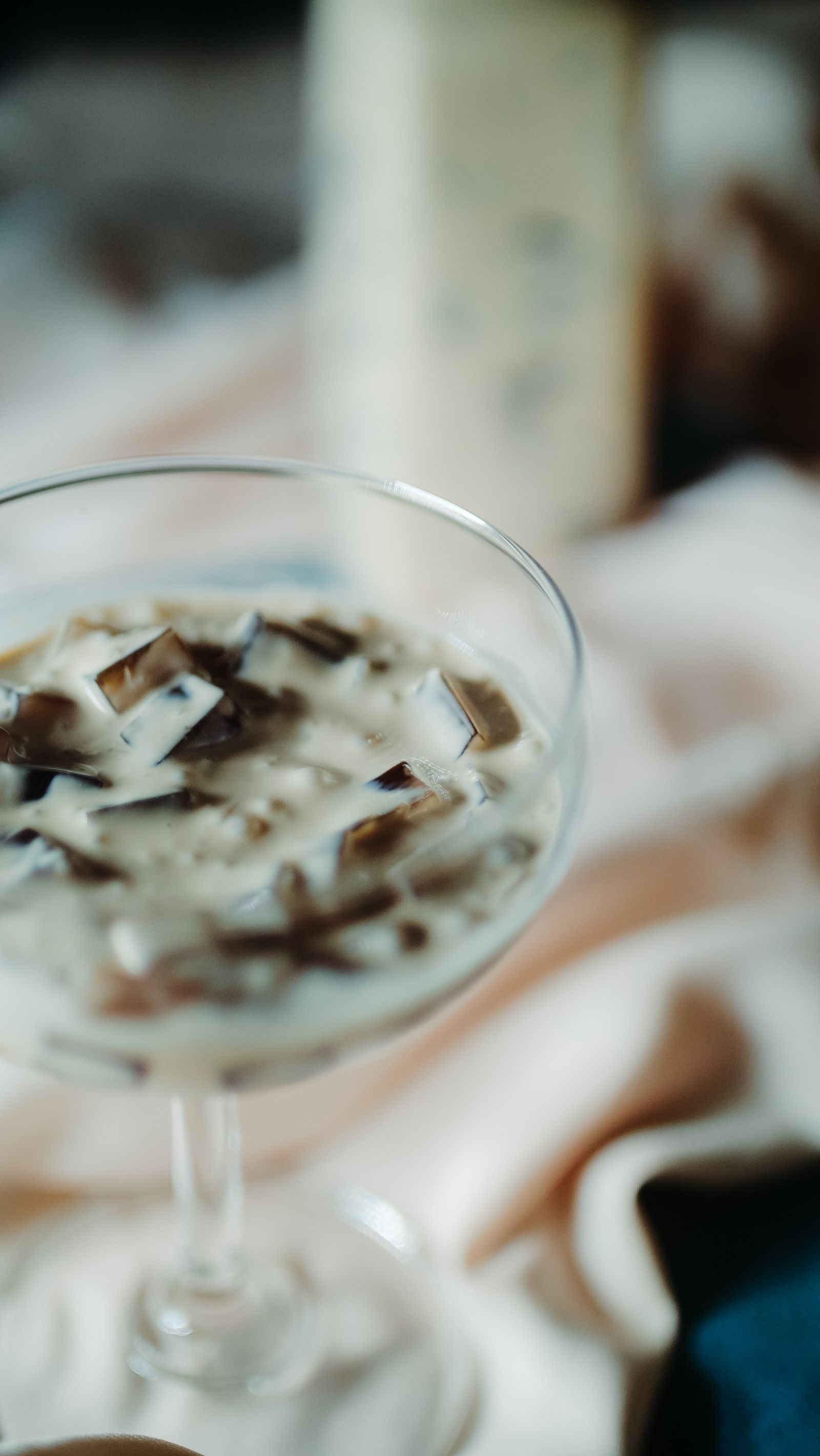
Coffee jelly is sweetened black coffee set into a soft gel, cut into cubes, and eaten cold with cream or milk poured over it. In Japan it is everywhere: on kissaten menus and in convenience store cases all summer, and blended into drinks at Starbucks.
It is also widely misunderstood outside Japan. The recipes you find in English almost always call for gelatin. The version you will actually be served in Tokyo is usually set with kanten — agar — and that one substitution changes the texture, the way it behaves in a drink, and how it eats.
Here is what it is, why the Japanese version feels different, where it came from (not Japan), and how to make either version at home.
What Is Coffee Jelly?
Coffee jelly — kōhī zerī (コーヒーゼリー), a loanword taken straight from English — is brewed coffee, lightly sweetened, set with a gelling agent and chilled. It arrives cut into cubes in a tall glass or a shallow bowl, with some combination of cream, milk, sweetened condensed milk, or simple syrup poured over the top.
The taste sits closer to iced coffee than to dessert. The jelly itself is barely sweet; nearly all the sweetness comes from what you pour on. Bitterness is not a flaw to be covered up here — it is the entire point, and the cold cream running between the cubes is what it plays against.
That framing matters, because Americans tend to hear "coffee jelly" and picture a coffee-flavored Jell-O cup. It is not that. Think of it as another way to serve cold coffee, one you eat with a spoon.
You will run into it three ways:
- On its own, in a glass with cream — the classic café order.
- Layered into a parfait, with soft serve, whipped cream, and corn flakes.
- Dropped into a drink, so cubes come up the straw of an iced latte or a blended coffee.
Its natural home is the kissaten, Japan's older and quieter style of coffee house — dim, wood-paneled rooms where the coffee is made one cup at a time and the menu has not changed in forty years.
Kanten vs. Gelatin: Why the Japanese Version Feels Different
Nearly every English-language recipe reaches for gelatin. Japanese coffee jelly is typically set with kanten (寒天) — agar, a gel extracted from red seaweed. The two are not interchangeable, and the difference is not subtle.
| Kanten (agar) | Gelatin | |
|---|---|---|
| Source | Red seaweed | Animal collagen |
| Must be boiled? | Yes — dissolves above about 194°F (90°C) | No — boiling ruins it |
| Sets at | Room temperature, around 90–105°F (32–40°C) | Refrigerator temperature |
| Melts at | About 185°F (85°C) | About 95°F (35°C) — just below body temperature |
| Texture | Firm, clean break, slightly brittle | Soft, wobbly, silky |
| In the mouth | Stays a distinct piece | Melts away |
| In an iced drink | Cubes hold their shape | Cubes soften and slump |
| Appearance | Slightly cloudy, matte | Glassy, translucent |
| Vegan | Yes | No |
The practical consequence is the one worth remembering: kanten does not melt at body temperature, and gelatin does. That is why a kissaten can drop cubes into an iced coffee and have them arrive intact, and why a coffee jelly Frappuccino works at all. It is also why the classic version eats the way it does — each cube stays a cube, with a clean edge that breaks under the spoon rather than dissolving on the tongue.
Gelatin gives you something genuinely nice, just different: silkier, wobblier, closer to panna cotta, and it disappears in the mouth. If you are eating it plain from a bowl, gelatin is a pleasure. If the cubes are going into a drink, use kanten or they will collapse.
Japan came to this with a long head start. Kanten is said to have been discovered by accident around 1658, when an innkeeper named Minoya Tarōzaemon in Fushimi, Kyoto, put leftover tokoroten — seaweed jelly noodles — outside in winter. It froze, thawed, and dried out over several days. Boiled back up, it set into a cleaner, odorless jelly that could be stored dry. The story has the polish of legend, but the result is real: Japan has had a shelf-stable plant gelling agent, and a culture of firm-set jellies, for over three centuries. Coffee jelly landed on well-prepared ground.
How Coffee Jelly Got to Japan
It is not a Japanese invention.
Recipes for coffee jelly appear in English cookbooks as early as 1817, in The New Family Receipt Book. It crossed the Atlantic and settled into New England, where it became a genuine regional dish — Boston's Durgin-Park is reported to have put coffee gelatin on the dessert menu in 1827, and the dish held on longest in Rhode Island. In the early twentieth century American marketers sold it as a gentler alternative to hot coffee, on the theory that the gelatin would soak up stomach acid. Jell-O even launched a coffee flavor in 1918. It did not last.
In Japan, coffee jelly took shape during the Taishō era (1912–1926), as an imitation of the European molded jellies then in fashion.
The turn from curiosity to café standard came later, and it can be dated. In 1963, Mikado Coffee put coffee jelly on the summer menu at its Karuizawa shop and sold it as taberu kōhī — "coffee you can eat." The company had been founded in 1948 in Nihonbashi Muromachi, Tokyo, by Kanasaka Keisuke, who by the company's account had spent a long time turning over the question of whether coffee could be eaten rather than drunk. His version came to the table with gum syrup, cream, and a pour of brandy: a dessert built for adults.
Mikado is often credited with inventing coffee jelly in Japan outright. That overstates it — the dish was already documented decades earlier. What the company can fairly claim is the thing that actually mattered: it made coffee jelly something you order in a café. Supermarkets and convenience stores followed, and it has been ordinary Japanese food ever since.
For the wider story of how the drink itself arrived, see how coffee took root in Japan.
How It's Served in a Kissaten
Order it in an old coffee house and it comes in a tall, footed glass. Dark cubes, roughly broken rather than precisely diced. A small pitcher of cream on the side, sometimes gum syrup, sometimes sweetened condensed milk. You pour, you stir once, you eat it with a long spoon.
What surprises most first-timers is the restraint. It is not a sweet course. The sweetness is deliberately left to the diner, in the same way an old kissaten will hand you sugar for your coffee rather than deciding for you — the same instinct behind the mōningu morning set, where the ritual is fixed but the plate stays plain.
It is also seasonal. Coffee jelly appears when the weather turns, sits on the summer menu next to kakigōri shaved ice, and quietly disappears in autumn. Mikado's brandy pour is still the reference for the grown-up version of the dish.
How to Make Coffee Jelly at Home
Brew it stronger than you would drink it
This is the step people skip, and it is the one that decides the result. Chilling mutes flavor, and cream, syrup, and milk dilute it further. Coffee brewed at normal drinking strength turns into a bland brown cube.
Brew at roughly 1:12 to 1:14 — about 45 g of coffee to 600 ml of water — instead of the usual 1:16. If ratios are new to you, start with coffee ratios explained, then use whatever method you already trust; our guide to Japanese pour over covers the technique.
Choose a medium to medium-dark roast. A delicate light roast, with its florals and acidity, gets erased by cold and cream. You want body and a clean bitterness that can stand up to dairy.
The kanten version (kissaten texture)
Makes about 4 servings.
- 600 ml (2½ cups) hot brewed coffee, strong
- 4 g kanten (agar) powder — 2 tsp, or one standard Japanese stick packet
- 60 g (⅓ cup) sugar
- Whisk the kanten powder into the coffee in a saucepan while it is still cool enough to stir smoothly.
- Bring to a full boil, then keep it boiling for 1–2 minutes, stirring. This is not optional — kanten will not set unless it truly boils.
- Off the heat, stir in the sugar until it dissolves.
- Pour into a shallow container. It sets at room temperature in about an hour, then chill for 2 hours before serving.
The gelatin version (silky texture)
- 500 ml (2 cups) hot brewed coffee, strong
- 10 g powdered gelatin (about 1 Tbsp), for cubes that hold their edges — use 7 g for a looser, spoon-through set
- 40 g (3 Tbsp) sugar
- 3 Tbsp cold water, for blooming
- Sprinkle the gelatin over the cold water and let it stand 5 minutes until it swells.
- Stir the sugar into the hot coffee, then let the coffee cool to around 140°F (60°C). Do not boil the gelatin — high heat weakens its setting power.
- Stir in the bloomed gelatin until fully dissolved.
- Pour into a container and refrigerate at least 4 hours, ideally overnight.
Serving
Cut into ½-inch (1.3 cm) cubes, or drag a spoon through the set jelly for the rougher, more traditional look. For the standard café topping, stir together equal parts sweetened condensed milk and milk — about 3 Tbsp each — and pour it over just before eating. Unsweetened cream with gum syrup on the side is the more austere option, and the one that lets the coffee show.
To put it in a drink, use the kanten version only. Spoon cubes into a glass and pour cold coffee or milk over them; Japanese iced coffee works especially well, since it is brewed to be bright and full-strength over ice.
Where to Try It in Japan
Convenience stores are the easiest entry point. Sealed cups of coffee jelly with a little tub of creamer sit in the chilled case at 7-Eleven, Lawson, and FamilyMart — most reliably in summer, when all three run seasonal versions. They are cheap, they are decent, and they are everywhere — part of the same everyday coffee infrastructure as canned coffee and vending machines.
Starbucks Japan ran a coffee jelly Frappuccino through the summer of 2016 — layered like a parfait, jelly at the bottom, with a straw wide enough to pull the cubes up — which is about as clear a signal of mainstream status as the dish could ask for.
Kissaten remain the best version, and the one worth planning around — go in summer, sit at the counter, and order it with cream on the side.
The Point of It
"Coffee you can eat" was a marketing line, but it is also an accurate description of what Kanasaka was after. Coffee jelly is not coffee-flavored dessert. It is coffee, held still, eaten cold, with cream running through it.
Make it with gelatin and you will get something good. Make it with kanten and you will get the thing itself.