Best Manual Coffee Grinders for Pour Over (2026), Judged by V60 Standards
Some links below are affiliate links. We may earn a commission at no cost to you. As an Amazon Associate we earn from qualifying purchases.
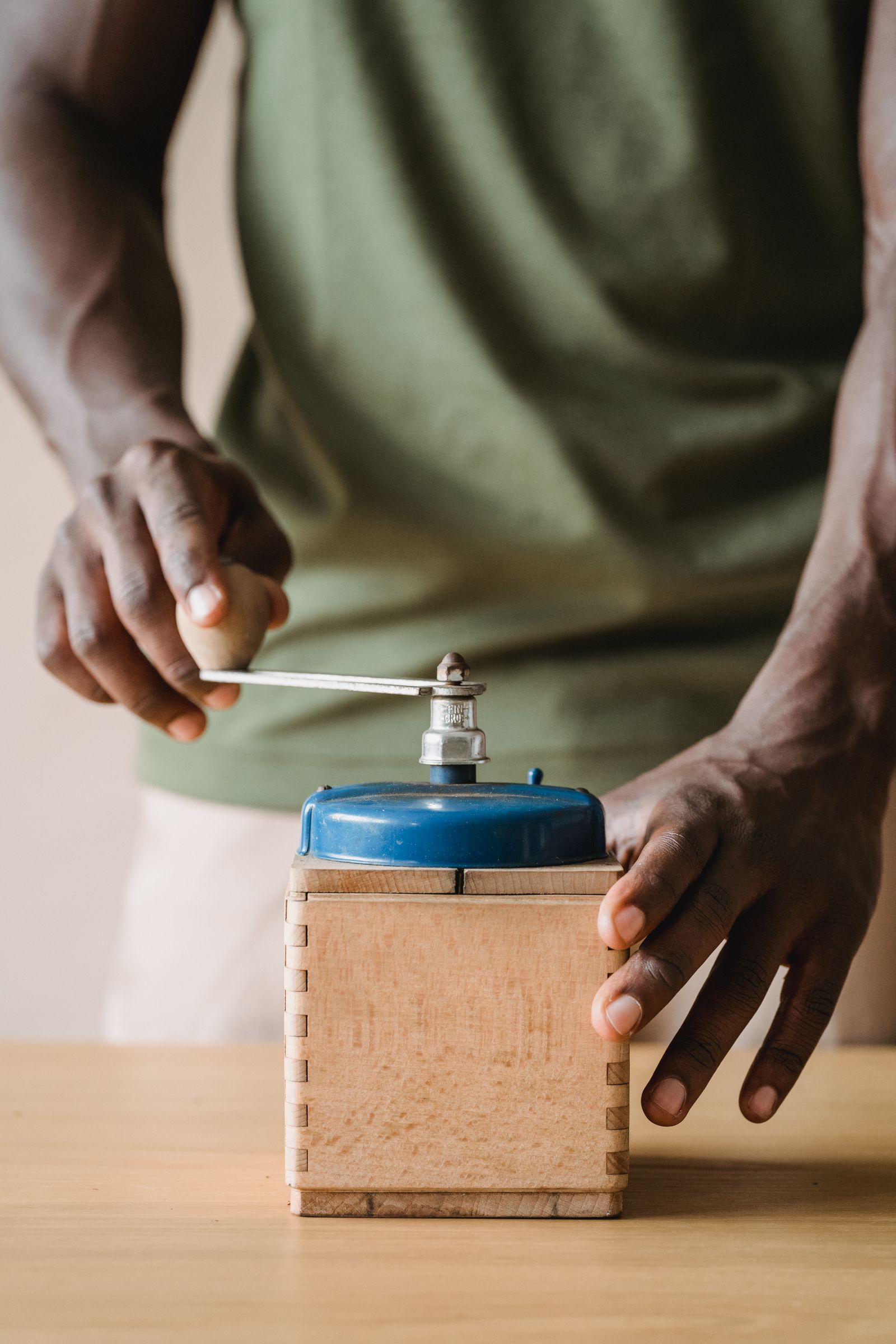
A V60 hides nothing. No metal filter catching fines, no pressure to paper over an uneven bed — just water, gravity, and however your coffee got chopped up. Which is why, for pour over specifically, the grinder is the gear that changes the most for what you spend.
The short answers: best overall, the 1Zpresso J-Ultra. Best value — and probably the right call for most people reading this — the Kingrinder K6. First grinder ever, the Timemore Chestnut C3.
Two things upfront. This isn't an all-around ranking: most lists blend espresso, French press, and filter into one verdict, while we ranked by what a V60 and the slow, multi-pour Japanese method actually demand. And we don't own these units. What follows comes from manufacturer specs and the published findings of reviewers who have run them side by side, with the disagreements flagged rather than smoothed over.
Still choosing a dripper? Start with our guide to the best Japanese coffee drippers.
Our Top Picks at a Glance
| Grinder | Best for | Burrs | Adjustment | Capacity | Origin | Price tier |
|---|---|---|---|---|---|---|
| 1Zpresso J-Ultra | Best Overall | 48mm titanium-coated steel, heptagonal | External, 100 clicks/rotation (8µm per click) | 35–40g | Taiwan | Premium |
| Kingrinder K6 | Best Value | 48mm stainless steel, heptagonal | External numbered dial, 60 clicks/rotation (16µm per click) | 25–30g | China | Mid-range |
| Timemore Chestnut C3 | Best for Beginners | 38mm S2C660 stainless conical | Internal dial, ~83µm per click | 20g | China | Entry-level |
| Hario Skerton Pro | Best Match for a V60 Starter Setup | Ceramic conical | Internal, stepped (not specified) | 100g hopper | Japanese brand; mill made in China | Budget |
| Porlex Mini II | Best for Travel | Ceramic conical | Stepped, ~37µm per click | 20g | Japan (Kirishima) | Entry-level |
| 1Zpresso JX-Pro S | Best for Filter Purists | 48mm stainless conical | External, numbered clicks | 30~35g | Taiwan | Mid-range |
| Timemore Chestnut C3 ESP | Best If You Might Add Espresso Later | 38mm S2C660 stainless conical | Internal dial, ~23µm per click, 30 clicks/rotation | 20g | China | Entry-level |
Figures are the manufacturers' published specs. Where a manufacturer doesn't publish a number, we've said so rather than filled the cell with a guess.
Short version: if you want one grinder to stop thinking about, the J-Ultra. If you want the same result for less and don't care how it looks on the counter, the K6.
How We Judge a Grinder for Japanese-Style Pour Over
A V60 hides nothing
The V60 is named for its 60-degree cone, and Hario's three design points are that angle, the twisted spiral ribs, and one large single hole at the bottom. That geometry barely restricts flow, which is the point — you control the brew with your pour.
It also means there's no safety net. An espresso basket has pressure and a fine screen; a French press has a metal mesh. A V60 has a cone of paper and a big open drain. When your grinder throws off a heavy tail of fines, they migrate down, choke the flow path, and over-extract into the bitterness you taste at the end of the cup.
So a lot of "my V60 tastes bad" isn't the dripper or the beans. It's grind consistency. (For the failure modes that aren't about grind, see common pour over mistakes.)
Repeatability for the slow, multi-pour method
The Japanese café approach — the kissaten style, from the old coffee houses that have poured the same cup for decades — is slow and deliberate: several small pours, long total contact time. And long contact time amplifies small errors. A grind that's a hair too fine costs little on a fast single-pour brew; over four minutes of staged pouring it can add a minute of drawdown and tip the cup into astringency.
That makes repeatability nearly as valuable as absolute grind quality. Can you read your setting as a number and return to it tomorrow, half-awake, without re-dialing from scratch? External numbered dials win this outright, and it matters more here than most roundups admit. See how to brew pour over like a Japanese café.
Burrs: size, material, and what actually changes the cup
Size. A 48mm-class burr set processes more coffee per turn, so it grinds noticeably faster — a gap the side-by-side reviews below show clearly. Larger burrs are also commonly credited with tighter particle distribution, but treat that as a tendency, not a rule: geometry and alignment do more work than diameter alone.
Material. Ceramic doesn't rust and resists wear well. Steel and titanium-coated steel grind faster, and here they're also the ones reviewers rate highest for uniformity — though that isn't proof the material is the cause, and two grinders below are ceramic.
Numbers. Published micron-per-click figures are manufacturer calculations derived from thread pitch, not measurements of what lands in your filter. They compare adjustment resolution; they don't promise a cup.
A note on where these grinders come from
Kissa Lab is based in Japan, and we'd love to tell you the Japanese grinders win. They don't — not on burr performance. The front edge of hand grinding sits in Taiwan (1Zpresso) and China (Timemore, Kingrinder).
We should be precise about the rest, too. Porlex genuinely is Japanese manufacturing: the company states the Mini is made at its own factory in Kirishima City, Kagoshima. Hario invented the V60 and the Skerton Pro is a Hario design, but Hario's own listing says the mill, handle, and lid are made in China — only the glass bowl is made in Japan. It's a Japanese product in the sense that matters least to your cup, and we'd rather say so than let the brand name imply otherwise.
We love Japanese gear. But this list is ranked on what ends up in the cup, not on patriotism.
The Best Manual Coffee Grinders for Pour Over
1Zpresso J-Ultra — Best Overall
The one to buy if you want to stop researching grinders.
It wins on balance, not any single spec: 48mm titanium-coated heptagonal conical burrs; external adjustment at 100 clicks per rotation, 8 microns per click; 35–40g capacity; folding handle and magnetic catch cup.
For a V60, 8-micron steps are almost comically fine — but the payoff isn't micro-tuning, it's that getting back to yesterday's setting is trivially certain, which is exactly what the slow multi-pour method rewards. The capacity also covers two cups at once, which matters on an 02.
The honest downside: much of what you're paying for is espresso-grade resolution. Brew only filter and you'll never use most of it.
Who it's for: daily V60 brewers who want this to be the last grinder they buy.
Check the 1Zpresso J-Ultra on Amazon
Kingrinder K6 — Best Value
The quiet hero of this list, and the right answer for more readers than the top pick is.
The K6 puts a flagship configuration — 48mm heptagonal stainless burrs and an external numbered dial — into the mid-range tier. Adjustment is 60 clicks per rotation at 16 microns per click, a figure Kingrinder publishes and reviewers repeat consistently, though the caveat above applies: it's calculated, not measured. Either way it's finer than a V60 needs, so it won't be your limiting factor. Where reviewers running it against pricier grinders converge is filter-range distribution, which multiple outlets rate as clearly strong for its tier.
The honest downside: fit and finish sit a step below 1Zpresso. Owners describe it as a tool rather than an object — it won't satisfy anyone shopping for something nice to look at.
Who it's for: results over looks, and putting the difference into better beans.
Check the Kingrinder K6 on Amazon
Timemore Chestnut C3 — Best for Beginners
The first real grinder.
Specs: 38mm S2C660 stainless conical burrs; internal dial adjustment at roughly 83 microns per click; 20g capacity; aluminum alloy body.
In the medium to medium-coarse range where V60 lives, it's steady. Coming from a blade grinder or pre-ground bags, this is the biggest jump in cup quality you'll ever buy — the step from "no grinder" to "a real burr grinder" dwarfs every upgrade after it.
The honest downside: adjustment is internal and unnumbered, so you can't read your setting — returning to it means counting from zero. And 83 microns is a coarse step: there's no such thing as a small correction here. Fine for a while, and then it isn't. This is why people trade up to a K6.
Who it's for: you just bought a V60 and want to find out what grinding properly feels like.
Before touching the grind, lock your ratio down — see coffee ratios explained. One variable at a time.
Check the Timemore Chestnut C3 on Amazon
Hario Skerton Pro — Best Match for a V60 Starter Setup
The budget entry point, from the company that invented the dripper.
Ceramic conical burrs, a 100g glass catch jar, and — the meaningful change from the original Skerton — a stabilizing shaft plus a lower burr spring that stops the burr wobbling under load.
That wobble fix isn't marketing: it was the old Skerton's exact weakness, and reviewers comparing the two report a real improvement in coarse-range uniformity on the Pro. Hario also designed the V60, the server, and the kettle — building a first setup from one house's thinking is a sensible way to start.
The honest downside: it's slow. Home Grounds clocks about a minute and ten seconds for 20g at medium-fine, against under 30 seconds for the same dose on a 1Zpresso JX. Uniformity doesn't reach the K6 or the 1Zpresso units. Glass breaks when dropped. And despite the Japanese brand, the mill itself is made in China.
Who it's for: budget first, and people building the whole rig in Hario's line. Also — genuinely — those who'd rather have the ritual than the speed. An extra minute at the crank isn't a problem in a kitchen already committed to pouring slowly.
Pair it with our Hario V60 recipe.
Check the Hario Skerton Pro on Amazon
Porlex Mini II — Best for Travel
Made in Japan, built to disappear into a bag.
Ceramic conical burrs, stepped adjustment at roughly 37 microns per click, about 20g capacity, stainless body. Porlex builds it at its own factory in Kirishima City, Kagoshima — the one unambiguously Japanese-made grinder here.
It nests inside an AeroPress chamber, which makes it the obvious answer for hotel rooms, campsites, and office drawers.
The honest downside: two of them. 20g caps you at a single cup — you cannot grind two V60 02 servings. And ~37 microns per click is the coarsest adjustment step in this list, which makes fine-tuning a pour over a blunt exercise.
Who it's for: a second grinder for travel. We won't recommend it as your only one.
Check the Porlex Mini on Amazon
1Zpresso JX-Pro S — Best for Filter Purists
The other correct answer, if espresso is truly off the table.
Note the S: 1Zpresso has replaced the original JX-Pro with the JX-Pro S, which adds a folding crank. A plain JX-Pro listed anywhere is old stock. The S carries 48mm stainless conical burrs, external numbered click adjustment, and a 30~35g capacity — tuned for the filter range rather than stretched down into espresso. You're not paying for resolution you'll never touch, and several outlets rate the line highly for V60.
The honest downside: it sits close enough to the J-Ultra to cause decision paralysis. So, bluntly: any chance you'll pull espresso someday, buy the J-Ultra. Genuinely zero chance, buy this and pocket the difference.
Check the 1Zpresso JX-Pro S on Amazon
Timemore Chestnut C3 ESP — Best If You Might Add Espresso Later
An entry grinder with a ceiling above it.
Same 38mm S2C660 burr family as the C3, but the internal dial steps at roughly 23 microns across 30 clicks per rotation — under a third of the C3's step — which is what pushes it into espresso territory. For someone brewing mostly pour over who suspects an espresso machine is in their future, it's cheap insurance, and the finer steps make daily V60 corrections less blunt than on the plain C3.
The honest downside: the dial is still internal and unnumbered, so the repeatability problem doesn't go away. And if you only ever brew pour over, most of that low-end resolution sits unused.
Check the Timemore Chestnut C3 ESP on Amazon
How to Choose: Match the Grinder to How You Actually Brew
- Just bought a V60 → Chestnut C3.
- V60 every morning, want to dial it in → Kingrinder K6.
- Want a forever grinder, or espresso might happen → 1Zpresso J-Ultra.
- Filter only, forever → 1Zpresso JX-Pro S.
- Travel a lot → Porlex Mini II, as a second grinder.
- Budget first, or building a Hario setup → Skerton Pro.
And a case for buying nothing: if you already own a 48mm grinder with external numbered adjustment, a new grinder is close to the worst upgrade available to you. Fresher beans and a known roast date will change your cup more than swapping burrs of the same class.
Where to Start on Grind Size for Pour Over
Don't memorize a number — learn the method. Start at medium to medium-fine, a touch coarser than granulated sugar. Then stop looking at the grounds and watch the clock instead. Finishing fast and tasting thin and sour? Go finer. Dragging, stalling, or clogging? Go coarser. Move one or two clicks at a time.
Fix your ratio first, though. Grind size is meaningless as a variable if your dose and water are drifting — see coffee ratios explained. Change one thing per brew, and check the common pour over mistakes list before you blame the grind.
What a Better Grinder Won't Fix
Being honest about the limits of the thing we're recommending:
- Stale beans. No burr set redeems coffee with an unknown roast date. Cheapest fix available, and nobody wants to hear it.
- A messy pour. If water lands unevenly, perfect grounds don't help. Fix the pouring technique first.
- A kettle you can't aim. A grinder won't compensate — see how to choose a gooseneck kettle.
- A dripper that doesn't suit you. Some people are happier on a flat bottom, full stop. Our dripper guide covers it.
A grinder is the first investment worth making. It isn't the last.
FAQ
Is a manual grinder good enough for pour over?
Yes. A V60 doesn't care how the coffee was ground, only how evenly. Mid-range hand grinders frequently beat electric grinders at similar prices on particle distribution, because none of your money goes toward a motor.
Kingrinder K6 vs 1Zpresso J-Ultra — which should I buy?
The K6 wins on value; the J-Ultra wins on adjustment resolution and finish. If you're building a V60-only setup, the K6 is functionally sufficient. The J-Ultra is worth it if you want espresso capability or simply want the nicer object.
Is the Hario Skerton Pro good for V60?
It brews good coffee, and the Pro's stabilized burr fixed the original's real flaw. But it's slower than the 48mm steel grinders here, and uniformity trails them. Its value is as a coherent, budget entry into the Hario V60 line.
How long does it take to hand-grind for pour over?
Depends on burr size. Home Grounds reports 20g in under 30 seconds on a 1Zpresso JX, against about a minute and ten seconds on the ceramic-burr Hario Skerton Pro. Expect small ceramic grinders to take roughly two to three times as long as a 48mm steel set.
Ceramic or stainless steel burrs for pour over?
Ceramic resists rust and wear. Steel and titanium-coated burrs grind faster, and the steel grinders here are the ones reviewers rate highest for uniformity. If uniformity is your priority, steel is the safer bet — though that's a tendency, not an absolute.
Do I need an espresso-capable grinder if I only brew V60?
No. That precision goes unused in the filter range. Put the difference toward better coffee and you'll taste it.
The Bottom Line
Buy the J-Ultra once and stop. Buy the K6 if you'd rather spend the difference on beans — that's most of you. Start with the C3 if you're starting.
A good grinder isn't about brewing faster. It's about returning to the same cup tomorrow, and the day after that. That's the unglamorous thing behind every kissaten counter that has served the same coffee for forty years — not inspiration, just a setting somebody can find again every morning.
For the wider context, see our overview of Japanese pour over coffee.