Kyoto-Style Cold Brew: Japan's Slow-Drip Coffee, Explained
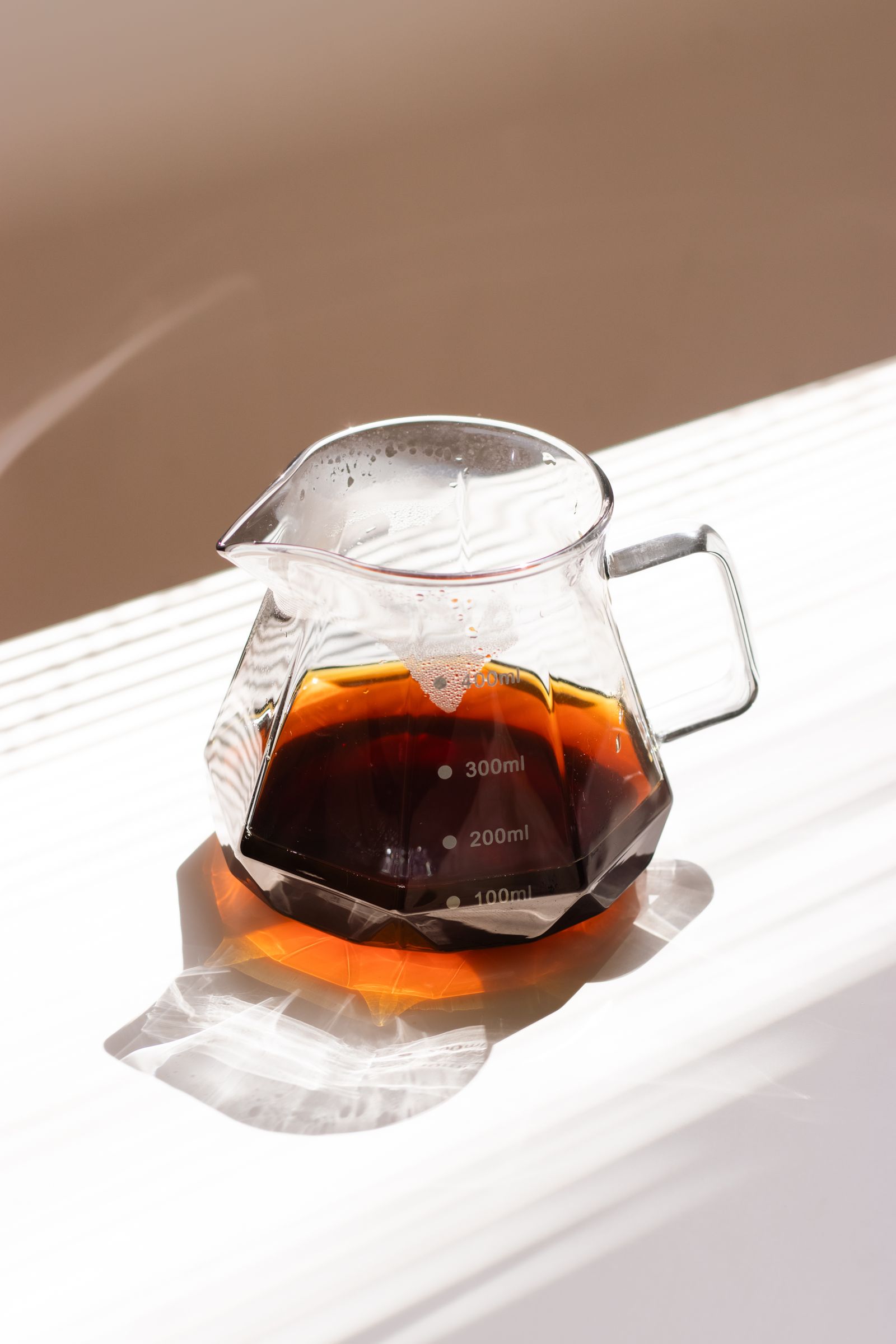
Kyoto-style cold brew sends cold water through a bed of coffee one drop at a time, over three to twelve hours. No heat, no stirring, no steeping — just gravity and patience. The result tastes unusually clean and sweet, with the bean's aromatics intact.
It isn't Japanese iced coffee, which brews hot onto ice in about five minutes. It isn't standard cold brew, which steeps grounds in a jar overnight. It's a third method, and confusing the three is why people brew it badly.
Below: how it differs from the other two, how a tower works, the ratio and drip rate, and how close you can get without one.
What Is Kyoto-Style Cold Brew?
Kyoto-style cold brew is percolation with cold water at an extremely slow rate. Water sits in a chamber atop a tall glass tower, passes through a valve, and falls drop by drop onto a bed of ground coffee, then into a server below.
That distinction does the work. In immersion, the same water sits with the grounds and slowly saturates; in slow drip, the water touching the coffee is always fresh, so the concentration gradient never flattens. Long contact, constantly renewed water — that's the clarity.
You'll see it called Kyoto drip, cold drip, slow drip, water drip, ice drip, and Dutch coffee (ダッチコーヒー). One note on the Japanese, which English articles garble: mizudashi (水出し), "water-drawn," is the umbrella term for cold-water coffee of any kind, and the real split is by mechanism — tentekishiki (点滴式), drip, versus shinsekishiki (浸漬式), immersion. "Dutch coffee" floats between the two, attaching most often to the towers.
Expect a flavor in the middle — brighter than a steeped cold brew, gentler than anything hot. It sits alongside the hot methods in our guide to Japanese pour over coffee, and like pour over, it hides nothing.
Kyoto Drip vs. Flash Brew vs. Immersion Cold Brew
These three get lumped together as "Japanese cold coffee." They're genuinely different drinks.
| Flash brew (Japanese iced) | Kyoto slow drip | Immersion cold brew | |
|---|---|---|---|
| Water temp | Just off boil, ~200°F (93°C) | Cold, 40–70°F (4–21°C) | Cold |
| Contact | Percolation | Percolation, drop by drop | Immersion |
| Brew time | 3–5 minutes | 3–12 hours | 12–24 hours |
| Gear | Dripper, kettle, scale, ice | Tower or DIY rig | A jar and a filter |
| Taste | Bright, fruity, aromatic | Clean, sweet, defined | Smooth, mellow, chocolatey |
| Best roast | Light to medium | Medium single origin | Medium to dark |
| Yield | One cup | Small batches | Large batches |
| Keeps | Drink immediately | About a week, chilled | 1–2 weeks, chilled |
Choosing: flash brew for one bright cup now, immersion for a mellow pitcher, slow drip for clarity and sweetness neither of the others gives you.
One correction, because most English articles get this wrong. "Kyoto cold brew is low acid" is too blunt. Cold extraction of any kind pulls fewer of the compounds behind sharp, sour edges than hot brewing does. But slow drip isn't the mildest of the three: published comparisons against steeped cold brew find the drip brews extracting more — more caffeine, more chlorogenic acid — because fresh water keeps arriving instead of sitting. On the palate that reads as more definition and a little more brightness. Middle position, not the low end.
The hot-water method has its own guide: our full Japanese iced coffee (flash brew) recipe.
Where Kyoto-Style Coffee Actually Comes From
The story on almost every coffee blog: in the 1600s, Dutch traders couldn't light fires aboard ship, so they brewed with cold water. It reached Japan through Nagasaki, and Kyoto refined it into the towers we know today.
Good story. Also repeated far more often than it's documented — no primary source we can find establishes the shipboard origin, the dates move with each retelling, and nothing suggests those ships carried anything like a tower. Treat it as legend.
What's on firmer ground is narrower, and more interesting:
- Coffee reached Japan through the Dutch, at their Dejima trading post in Nagasaki — that much is documented. The leap from "the Dutch brought coffee" to "the Dutch invented cold drip" is where the evidence stops.
- In Japan the method is still called Dutch coffee. Whatever the origin, the association is baked into the name.
- The tower became a fixture of the kissaten, Japan's old-school coffee house — a wood-and-velvet room nothing like a modern café. Never as common on those counters as the siphon, but a familiar sight through the Showa era, and treated the same way: equipment kept in the open.
- That's Japan's contribution — turning a slow extraction into something you watch. It's why the world says "Kyoto-style" at all.
Sit at a kissaten counter and the tower does nothing dramatic: a drop forms, hangs, falls. The coffee you ordered was started yesterday. More: how coffee took root in Japan.
How a Drip Tower Works
A tower is three stacked chambers and one adjustable part.
- Top: the water chamber. Cold water, ice, or both. A valve or needle at its base sets the drip rate. This is the control.
- Middle: the grounds chamber. A paper or ceramic filter below, a level bed of coffee, and a paper disc on top to spread each drop.
- Bottom: the server.
Drip rate is the only variable you adjust during the brew. Set one number, walk away.
Towers worth knowing:
- Yama — hand-blown borosilicate glass in a wood or bamboo frame, with a glass coil that lengthens the drop's travel. Ceramic disc plus paper filtration; the common home size holds about 32 oz.
- Oji — hand-made in Japan in small numbers, built around a two-chamber reservoir that holds pressure steady as the top empties, so the drip rate drifts less. A multi-head diffuser spreads the water.
- Hario Water Dripper — Japanese-manufacturer minimalism: few parts, an adjustable spout, a metal filter with paper discs. The clear model fills about 780 ml in eight hours.
What decides whether you keep using one: how precisely the valve holds a setting, and how easily it comes apart to wash.
The Kyoto Slow-Drip Recipe
Start here, then adjust — every number is a starting point, not a rule.
Ratio: 1:10 is a solid default — 60 g coffee to 600 g water (about 20 fl oz). Published recipes run 1:8 to 1:12 — concentrate to dilute at one end, drinking strength for ice at the other. Decide which you want, then see why brew ratios work the way they do.
Grind: medium to medium-coarse, roughly what an auto-drip machine takes; tower makers recommend the coarser end, blogs the finer. Too fine and the bed clogs, too coarse and you've spent hours on something watery.
Method:
- Add the grounds and level the bed with a light tap. Don't tamp.
- Lay a paper disc on top to spread the drops.
- Pre-wet with just enough cold water to dampen everything, then wait 45–60 seconds. Dry pockets pull the brew off center.
- Fill the top chamber with cold water, ice, or a mix. Ice slows the drip as it melts — forgiving, but harder to time.
- Open the valve to one drop every 1 to 2 seconds, roughly 30–60 a minute — makers often say one per second, most recipes nearer 1.5–2. Check again at 15 minutes; valves drift.
- Let it run 3–12 hours, depending on volume, grind, and tower.
- Seal it and rest it in the fridge 12–24 hours. Standard practice in Japan and easy to taste: edges soften, sweetness comes forward. An empirical rule, not documented chemistry.
- Pour over ice; go nearer 1:8 if you'll add milk.
| Coffee | Water | Approx. run time |
|---|---|---|
| 40 g (1.4 oz) | 400 g (13.5 fl oz) | 3–6 hours |
| 60 g (2.1 oz) | 600 g (20 fl oz) | 5–9 hours |
| 80 g (2.8 oz) | 800 g (27 fl oz) | 7–12 hours |
Storage: sealed and refrigerated, about a week — shorter than immersion cold brew. For beans that reward it, see Japanese roasters worth seeking out.
No Tower? Two Ways to Get Close at Home
Towers are expensive and tall. Two honest alternatives, with their real limits.
Option 1 — Build a simple drip rig
Bottom to top: a server, a dripper with paper and grounds, and above it a plastic bottle hung upside down with a pin hole in the cap, filled with cold water or ice.
Hole size sets the drip rate. Start with the smallest hole you can make and widen it if it's too slow — you can't shrink it back. Aim for that same drop every 1 to 2 seconds.
The caveat: a bottle drips in exactly one spot, so channeling is the default failure and the paper disc isn't optional. The rate drifts as the bottle empties, so check every couple of hours. A flat bottom beats a cone — a flat-bottom dripper like the Kalita Wave keeps the bed even under a single drip point, and if you're choosing one, see which Japanese dripper to use.
Option 2 — Get the clarity without any rig
Tune an immersion cold brew toward the Kyoto end: grind medium instead of coarse, steep 8–12 hours rather than a full day, then — the part that matters most — filter the finished brew through paper in a pour over dripper.
Straight up: this is not Kyoto slow drip — percolation and immersion extract differently. But the qualities most people are chasing, clarity and a clean finish, come through at maybe eighty percent, for a fraction of the effort.
Try Option 2 first. If that clean, light-bodied profile is what you want, build a rig or buy a tower — as much a time-and-ritual object as a flavor tool.
Dialing It In and Fixing Problems
Thin and watery. Drip too fast, grind too coarse, or ratio too wide. Close the valve a notch, go one step finer, pull toward 1:10.
Bitter, heavy, or cloudy. The opposite: the drip crawled and over-extracted, or the grind choked the bed. It can also mean the coffee sat out after the last drop — refrigerate it as soon as it's done.
It stopped partway. Grind too fine, a tamped bed, or no paper disc, which lets the surface silt over and seal. Level the bed, never compress it, use the disc.
Only part of the bed is wet. Channeling — drops landing in one spot and boring through. The disc plus a proper pre-wet fixes nearly every case. These are the same extraction mistakes that show up in pour over, in slow motion.
Bean choice. This method hides nothing. A medium-roast single origin pays off; dark roasts go flat and ashy and belong in an immersion batch. Particle size matters more than usual over a long percolation, so a grinder that holds a consistent grind earns its place.
Is a Kyoto Drip Tower Worth Buying?
Buy one if you drink cold coffee year-round, you like equipment as equipment, or you want the cleanest possible expression of a good single origin.
Skip it if you mainly need volume — on coffee per unit of effort, a tower loses to a jar of immersion cold brew, and it isn't close. Skip it too if counter space is tight; a common home model stands around two and a half feet tall.
Three things to check: how finely the valve adjusts and whether it holds its setting, how completely it disassembles for cleaning, and its real height against your cabinets. Prices span a wide range. For the rest of the lineup, here's our guide to Japanese coffee drippers.
Frequently Asked Questions
Is Kyoto-style cold brew the same as regular cold brew?
No. Regular cold brew steeps grounds 12 to 24 hours. Kyoto-style is percolation: cold water drips through and never sits — cleaner and more defined, but it needs a tower.
Is Kyoto cold brew the same as Japanese iced coffee?
No. Japanese iced coffee, or flash brew, uses near-boiling water in a dripper and lands on ice in three to five minutes. Slow drip uses cold water, over hours.
How long does Kyoto-style cold brew take?
Three to twelve hours to finish dripping, depending on batch size, grind, and drip rate. Most people then rest it in the fridge another 12 to 24 hours — budget a day and a half.
What ratio should I use?
Start at 1:10 — 60 g coffee to 600 g water. Recipes range from 1:8 to 1:12: nearer 1:8 for a concentrate to dilute, 1:12 for drinking it straight.
Is Kyoto-style cold brew less acidic?
Gentler than hot-brewed coffee, but "low acid" oversimplifies. Against a long immersion cold brew, slow drip tastes brighter, and lab comparisons find it extracting more, not less. Call it the middle.
Can I make it without a tower?
Yes. Build a rig with a pin-holed bottle over a dripper and server, or tune an immersion batch: medium grind, 8 to 12 hours, filtered through paper.
How long does it keep?
About a week, sealed and refrigerated — shorter than immersion cold brew, which holds one to two weeks. Flat and dull rather than sweet means it's past its best.
Does it have more caffeine than cold brew?
In lab comparisons at a matched dose, drip comes out higher than steeping. In your glass, though, ratio and dilution decide it — concentrate hits harder than ready-to-drink, either way.
The Short Version
Kyoto-style cold brew is the third way to make cold coffee: cold water, dripped through the bed one drop at a time, for hours. The time buys clarity, sweetness, and aromatics that survive intact. Without a tower, a paper-filtered immersion batch gets you most of the way there tonight.
Read next:
- The 5-minute Japanese iced coffee — the hot-brew-over-ice method, start to finish
- The full guide to Japanese pour over — where all of this fits together
- What a kissaten actually is — the cafés these towers came from